



Selecting an office location for a dental business requires factors other than size and the appearance of the premises. Accessibility, design, utilities, terms of leasing, and other factors can determine whether the premises are appropriate for conducting medical activities. Those who research HPRG Washington medical offices might also discover more varied commercial property offers for health care-oriented businesses.
Types of Dental Office Spaces
Dental clinics can be located in different kinds of commercial buildings. In traditional office buildings, flexible interior space arrangements might be available that will enable the creation of a space arrangement for the treatment area, waiting room, administrative area, and storerooms.
As another alternative, there is a medical office building which might be specifically designed for healthcare organizations and has infrastructural support for clinical activity. In addition, there is a possibility to consider a former dental office, which will have some of the specific facilities, such as a treatment area with plumbing connection, cabinetry, lighting, etc.
Location and Accessibility
Locational factors play a key role in commercial real estate, especially when business operations involve scheduled appointments. A dental office should be located in a convenient area for its patients and staff members.
There are several neighborhoods in Washington, D.C., and they differ in their transportation facilities. A location near Metro, bus stops, roads, and walkways could make the place more convenient. Availability of parking lots could be a valuable criterion, especially when considering patients arriving in cars or having certain difficulties walking.
The neighborhood surrounding the property under consideration could have an effect on the number of potential patients as well. The density of residents, neighboring businesses, and demographics are some of the locational factors that could be taken into account while making a decision.
Layout and Space Requirements
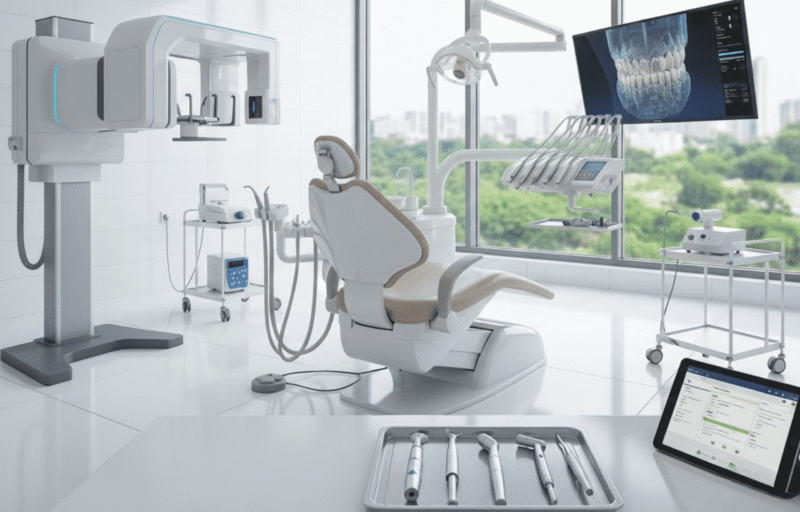
The dental office has some special spatial needs which differentiate it from typical offices of professionals. It is necessary to provide enough room in treatment rooms for dental chairs, equipment, and staff. In addition, reception areas and waiting rooms should be comfortable and should not disturb the process of providing services.
Sterilization rooms, storage for supplies, staff areas, offices for administration, and bathrooms could be included in the design of the office as well. The arrangement of all of these rooms can affect the flow of patients and the effectiveness of the process. An office may seem large enough, but it might not be efficiently arranged. Consequently, potential tenants should take into account not only square footage but also the possibility of its effective arrangement.
Infrastructure Considerations
Dental practices will rely on infrastructure which may be larger than what is needed by regular office tenants. The plumbing, electricity capacity, ventilation, lighting, and waste disposal systems may all contribute to how suitable a particular building is for such practice. Some equipment for dentists may need a separate electric connection or particular configuration of utilities.
Having several dental offices may lead to increased demand on plumbing and ventilation systems. If a particular office is evaluated for use, it needs to be determined whether there is enough infrastructure in place to conduct the desired activity, or renovations will be necessary. Such factors play a major role in the cost of renovations.
Lease and Buildout Considerations
The commercial leases themselves may differ greatly in terms of cost and structure. The base rent is often only one part of the overall cost of the lease, where other expenses related to the lease may include operating costs, maintenance fees, utility costs, and many others, depending on what was negotiated.
Another term that may affect the economics of a lease is the build-out or tenant improvement provision. Leasing an office that needs extensive build-out may differ greatly in its financial aspect from a space that was used for clinical work earlier. Knowing all those terms may be useful when negotiating a lease.
Evaluating Long-Term Suitability
However, when deciding on the evaluation of space within a dental office, there is always an aspect of current needs and future needs. The practice will have a need for more treatment rooms, administration space, better accessibility or new technology as it grows. In Washington, D.C., where there are various kinds of commercial real estate due to the diversity in the area, the person who is looking at the HPRG Washington medical offices can take advantage of considering all these factors together rather than just size and rental rate of the property.